Home Battery Rules Change on 1 May 2026
Size and Timing Now Matter More than Ever
If you are looking at a home battery, the next few weeks matter. From 1 May 2026, the federal Cheaper Home Batteries Program changes.
The subsidy reduced by $1000’s via a change in the STC factor that generates the subsidies for 2026, this drops from 8.4 for batteries installed in January to April to 6.8 for batteries installed from May to December, and the support also tapers by battery size. That means this is no longer just a question of which battery brand to buy. It is now a question of how big, how it will be used, and whether it can actually be installed and certified before 1 May. Under the program, the key date is the date the certificate of electrical compliance is issued.
Why Timing and Size Now Matter
A simple example shows why these matters. A 28-kWh usable battery installed before 1 May works out at about 235 STCs. The same battery installed from 1 May drops to about 152 STCs. That is roughly 35% fewer STCs just because the job finished later. A 40 kWh usable battery is hit harder: about 336 STCs before 1 May, versus about 165 STCs from 1 May onward. That is roughly 51% fewer STCs. These figures are worked from the government’s published factors and taper bands.
So the real question is not “how big can I go?” but “what size actually suits the house?”. The Department’s own guidance is blunt: bigger is not always better. A battery that is too large for the solar array or inverter can limit the benefit to the home and the grid. (DCCEEW)
In NSW, there is another catch. The NSW VPP incentive says batteries between 2 and 28 kWh are eligible, but also says batteries 28 kWh or larger are not eligible. So if you are looking at the edge of that range, the exact size needs to be checked carefully rather than assumed. (NSW Climate and Energy Action)
Testing the Right System for the House
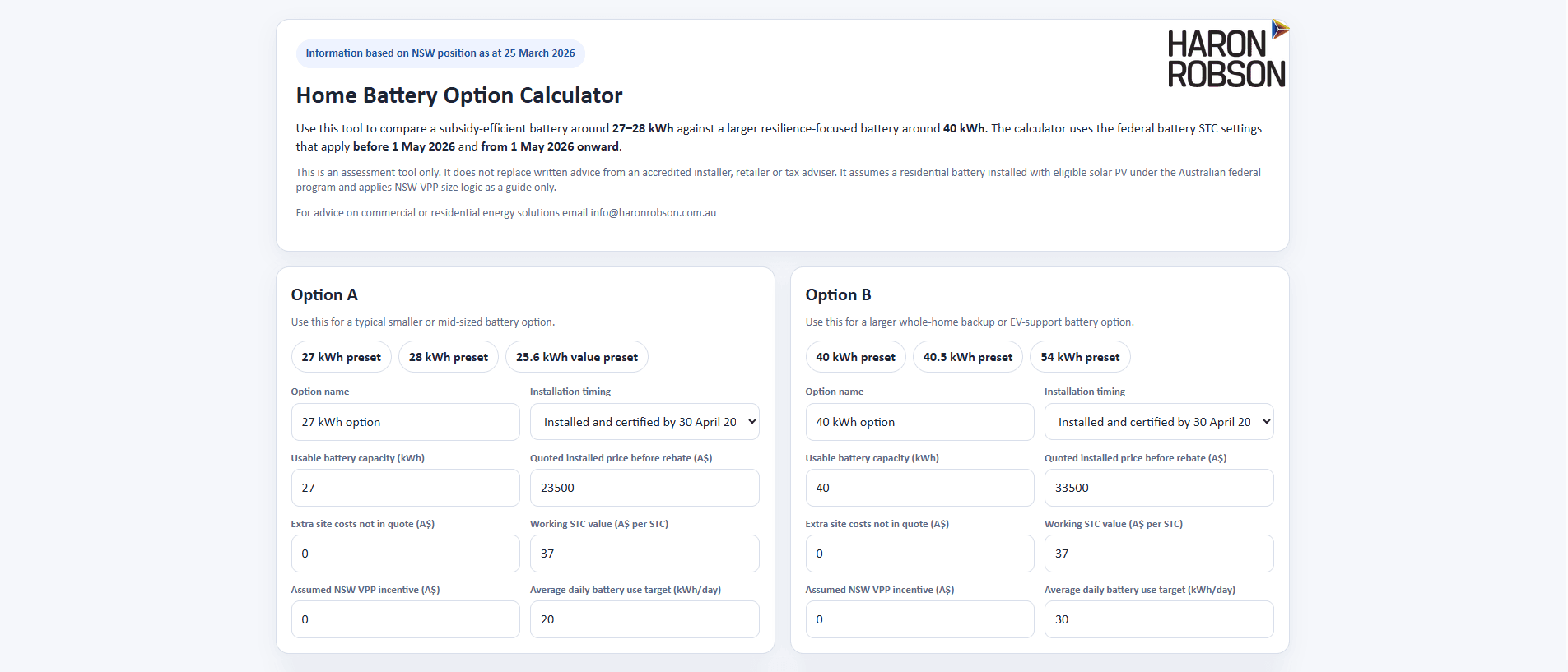
That is why I have put together a calculator that helps test the effect of battery size, timing, roof area for solar PV, orientation, shading, occupancy pattern, what will be powered by the battery, what will charge the battery, and whether the project is more likely to suit single-phase or three-phase supply.
A couple of practical examples:
- A home with enough roof for around 10–12 kW of PV, moderate evening use and essential-circuits backup may point to a battery in the 20–28 kWh range.
- A larger electrified home with EV charging, heavier overnight use and a whole-home backup intent may point toward a battery around 40 kWh or more — but that bigger system is far more exposed to the 1 May rule change.
Before You Lock It In
The point is simple: before locking in a battery, check the effect of size and timing properly.
Checkout the calculator for real costs effects of the change, or project-specific advice, contact info@haronrobson.com.au.