Solar Beyond the Rooftop
Why Flexible PV Could Change Building Design
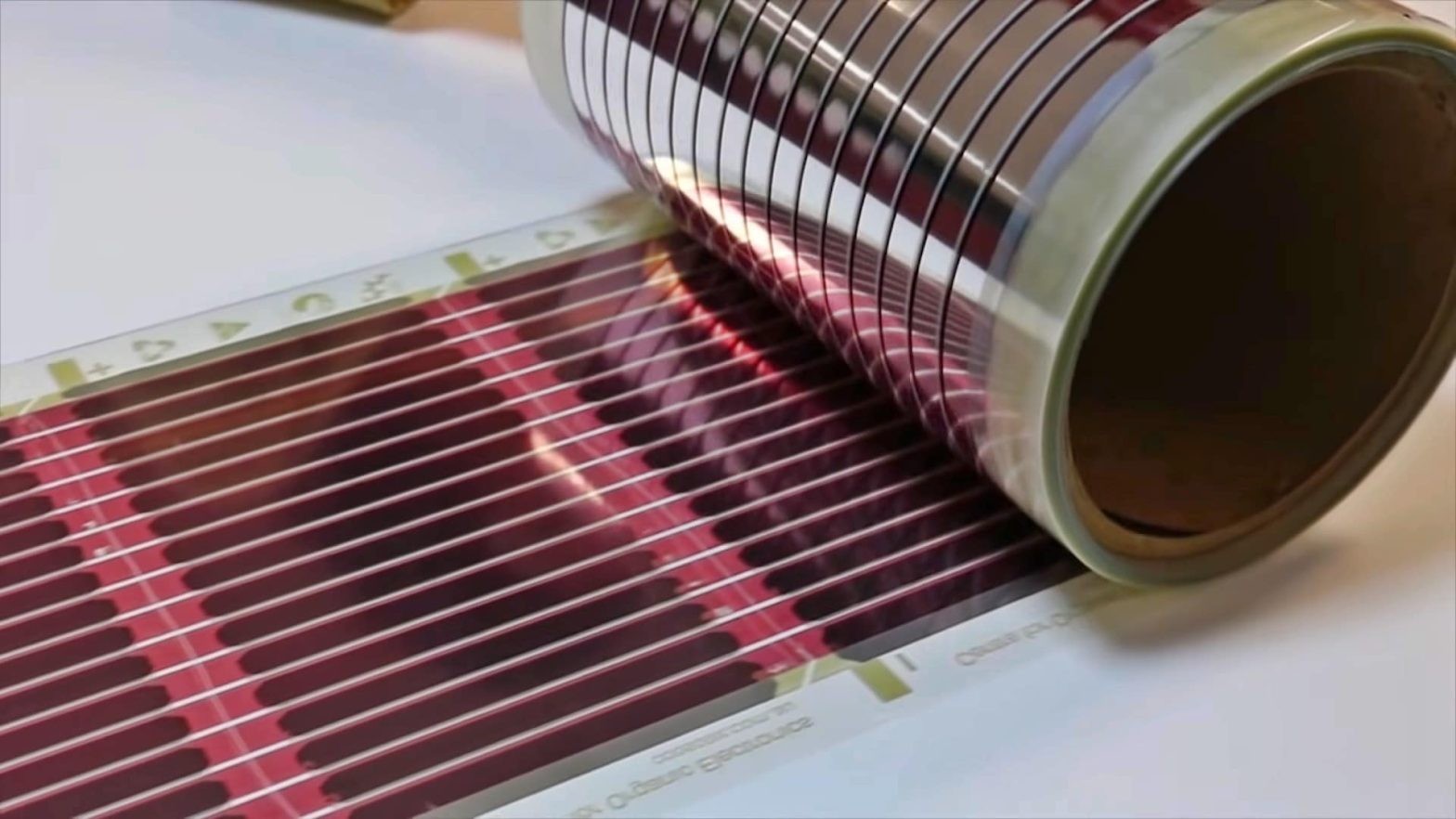
Most solar in buildings is still treated as a bolt-on rooftop system. That made sense when solar meant rigid silicon panels, heavy framing, limited mounting options and installation methods that sat outside normal building trades. But the next wave of solar may look very different. A March 2026 MIT Energy Initiative article on Active Surfaces describes a lightweight, flexible perovskite solar film designed to be applied to roofs, walls and curved surfaces, with the ambition of making solar far easier to deploy across the built environment. According to the article, the film is produced using a non-toxic perovskite ink, can be as thin as 15 microns, and is being developed to deliver similar electricity output to silicon over the same surface area while being lighter, more flexible and simpler to install.
That matters because the real limit on solar in cities is often not sunlight alone. It is the amount of practical surface area that can be
used without compromising structure, architecture, waterproofing, access, aesthetics or cost. The MIT article makes the point that the
industry needs to start thinking about “more and more places to put solar”, and that installation cost is a major barrier for conventional
rooftop systems. If solar can be supplied in a form that rolls out more like a roofing membrane or shingle rather than a rigid panel system,
then more of the building skin starts to become energy-producing real estate. That is the real promise here: not just cheaper solar, but
solar that fits the way buildings are actually assembled.
Expanded Opportunities Across Building Types
For building applications, this opens up a much wider field than the traditional top-floor plantroom roof. In multi-unit residential buildings, the biggest opportunity may not be individual apartment balconies or token rooftop arrays, but the ability to spread generation across podium roofs, lift overruns, awnings, façade zones, upper-level setbacks, service screens and potentially selected wall surfaces with useful solar access. In office buildings and other tall buildings, where roof area is small relative to total floor area, the logic is even stronger. A vertical building has enormous external surface area but very little conventional solar roof space per occupant. If lightweight PV can genuinely become durable, safe, cost-effective and easy to integrate, it could help shift solar from being a rooftop afterthought to a broader envelope strategy. That does not mean every wall becomes a power station, but it does mean designers should stop assuming that future building-integrated generation will be limited to rigid panels on the top of the building. This is an inference from the technology direction described in the source, not a claim that all such applications are already commercially proven.
The source article also highlights why this concept is attracting attention. Active Surfaces says the technology is based on more than 10 years of MIT research, the company has raised more than US$10 million in funding and grants, and it is developing roll-to-roll manufacturing intended to reduce production cost and support more distributed manufacturing. The article also notes a broader market context: worldwide installed solar capacity exceeded 2 terawatts in 2024, while some experts believe around 20 terawatts may be needed by 2050. That kind of growth target cannot be met comfortably if solar remains constrained to a narrow set of conventional rooftop situations. New application surfaces are part of the answer.
So what should building designers be allowing for now? First, they should protect solar-capable surface area rather than design it out. Too many buildings still consume valuable sun-exposed roof and façade zones with clutter, poorly planned services, screening that ignores orientation, or façade treatments that leave no practical route for future energy capture. Second, designers should think in terms of “energy-ready envelope zones”. That means identifying roof, parapet, awning and façade areas that could support future integrated PV systems, even if a specific product is not yet nominated. Third, the building should include sensible electrical pathways and riser capacity for future distributed generation. If future PV is likely to appear on more parts of the skin, then cable routes, junction locations, isolator positions, metering strategy and inverter or power-conversion spaces need to be thought through early. Otherwise the retrofit becomes messy, expensive and visually compromised.
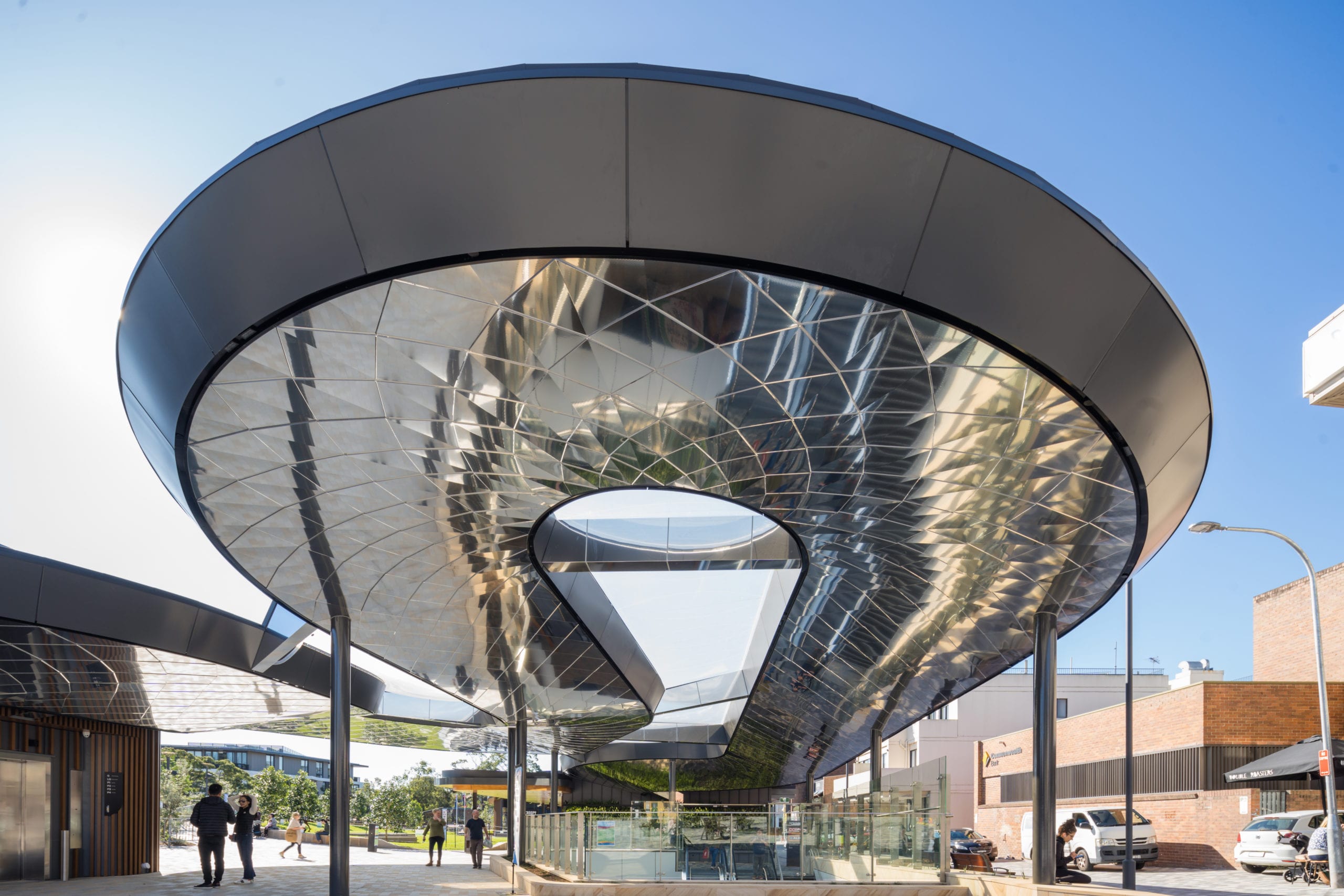
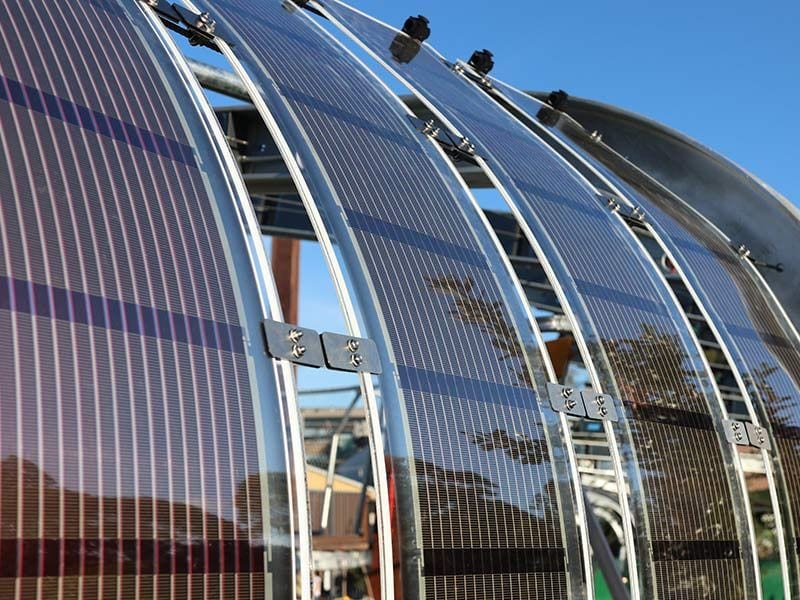
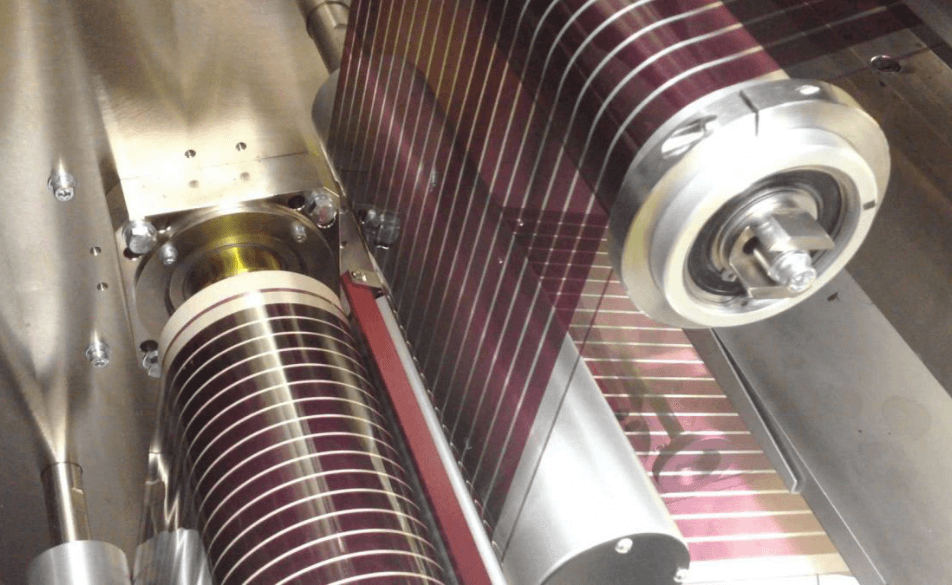
The Canopy, Lane Cove
Lane Cove Council hosted a public trial of printed flexible solar cells developed by the University of Newcastle. Multiple reports describe
the material as ultra-lightweight and ultra-flexible, integrated into a lattice walkway / public shade structure, with the solar collected
during the day and used to power an interactive light display at night.
Source: www.ipwea.org
Building Types, Limitations and Takeaway
For multi-unit residential buildings in particular, future allowances should also include planning for shared generation models rather than assuming only a small common-area system. As building electrification expands, the load profile of residential buildings is shifting. More electric hot water, more induction cooking, more air-conditioning, more lift usage and more EV charging all point in one direction: demand for daytime and stored electricity will rise. If solar technology becomes lighter and easier to deploy on multiple surfaces, then apartment buildings may eventually be able to do more than shave common-area loads. They may support deeper building-wide energy strategies, especially where coupled with batteries, load control and embedded energy arrangements. That outcome is not guaranteed, but it is a realistic reason to design now for flexibility later.
In offices and other commercial towers, the key issue is usually the mismatch between large energy demand and limited roof area. That is why future PV-ready thinking should include façades, sunshades, rooftop enclosures, plantroom screens and any architectural elements that receive meaningful solar exposure. Designers should also allow for safe maintenance access, cleaning, replacement sequencing and integration with façade maintenance systems. If the next generation of solar is thin, flexible and embedded into building surfaces, maintenance and replacement strategy become just as important as generation capacity. The product may be light, but the operational implications are not.
There is, however, a reality check. The MIT article makes clear that this is an emerging technology still scaling up. Active Surfaces’ films are reportedly growing rapidly in size, but at the time of the article were not yet full-sized commercial modules, with current machine capacity reaching 6 inches by 2 feet. The article also reports confirmed durability exceeding 10 years under realistic temperature and humidity conditions, which is promising, but still a different conversation from the long operating history and bankability of mature silicon panel systems. In plain terms, this is not a reason to stop using conventional solar where it works today. It is a reason to stop designing buildings as if conventional solar is the only form solar will ever take.
The practical takeaway is simple. Building designers should begin treating future solar integration as part of envelope planning, service coordination and long-term asset strategy. In vertical buildings especially, the question is no longer just how many panels fit on the roof. The smarter question is how much of the building could be made solar-ready without compromising architecture, compliance, waterproofing, maintenance or cost. If technologies like the one described by Active Surfaces continue to mature, the winners will be the buildings that left room for them.
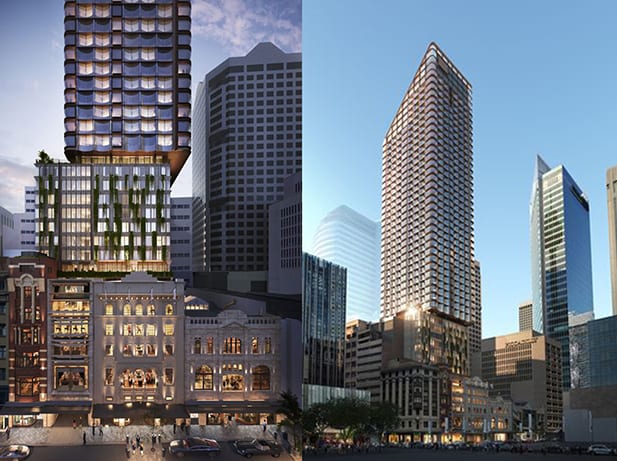
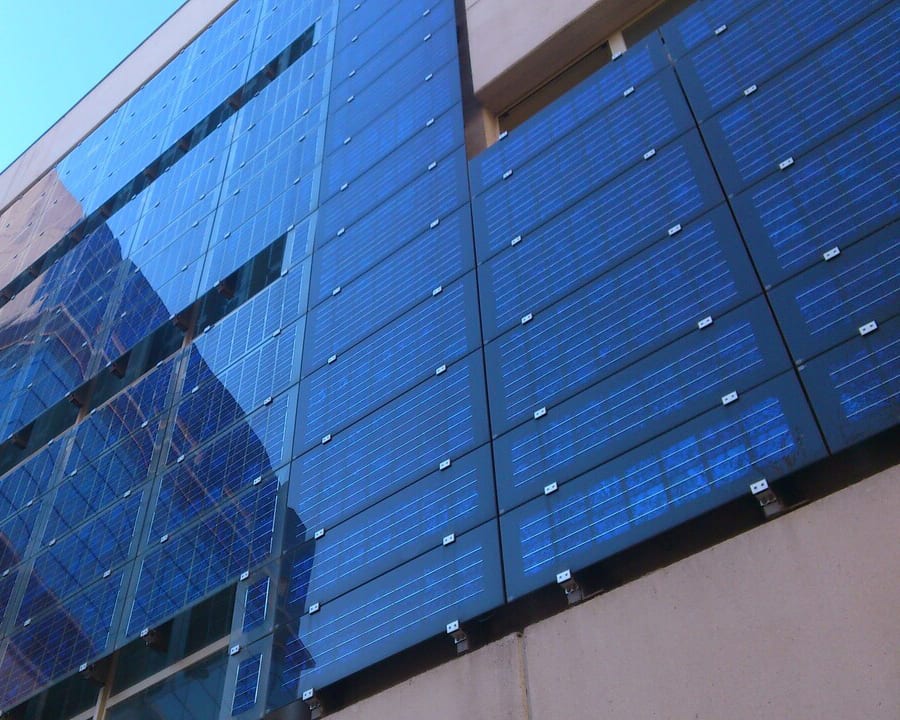

The Tattersalls Club
ClearVue, a Perth-based building-integrated photovoltaic (BIPV) company, will supply solar-generating feature glass for the redevelopment of
Sydney’s Tattersalls Club, a project valued at $308 million. The installation will span the roof terrace between levels 44 and 50, using
black BIPV glass designed to produce energy.