Thinking vs Doing = Saving $3m Plus $400k
Good Engineering Should Create Upside
We were asked to review a retirement village project that, on paper, was already resolved... We pitched for the project, the client to the lowest fee and that was the end of it… we thought. But the numbers told a different story. The budget for the electrical services was $3 million but the documented and priced design sat at $6 million and the client’s budget as just $3 million. That cheap fee didn’t seem so cheap anymore. Help us!
The design and documentation had been prepared by a well-known three-letter international design practice and a reviewed by national
engineering consultant three letter consultant. Experienced teams. Capable people. The documentation was thorough and compliant. And their
thoughts on possible savings? About $6,000 in savings. Which, in the context of a $3 million problem, is effectively no change at all.
The Real Issue
The issue wasn’t that the design was wrong. It was that it hadn’t been questioned costed or realistically reviewed before if left the
designer’s office. It followed familiar patterns—established plant principles, typical distribution strategies, standard allowances for
space and capacity. Everything was logical in isolation. But taken together, it locked in a level of cost and complexity that the project
simply couldn’t carry. This is what happens when engineering becomes an exercise in applying what’s known, rather than interrogating what’s
needed. The work had been done. But the thinking hadn’t.
A Different Approach
We approached it differently – our normal way. Not by starting with the drawings, but by stepping back and asking what the building actually required—and just as importantly, what it didn’t. What became clear quickly was that the electrical services weren’t just oversized. They were structured around assumptions that drove both cost and geometry. The way the systems were arranged dictated the size of risers, the congestion in corridors, and ultimately the footprint of the building itself.
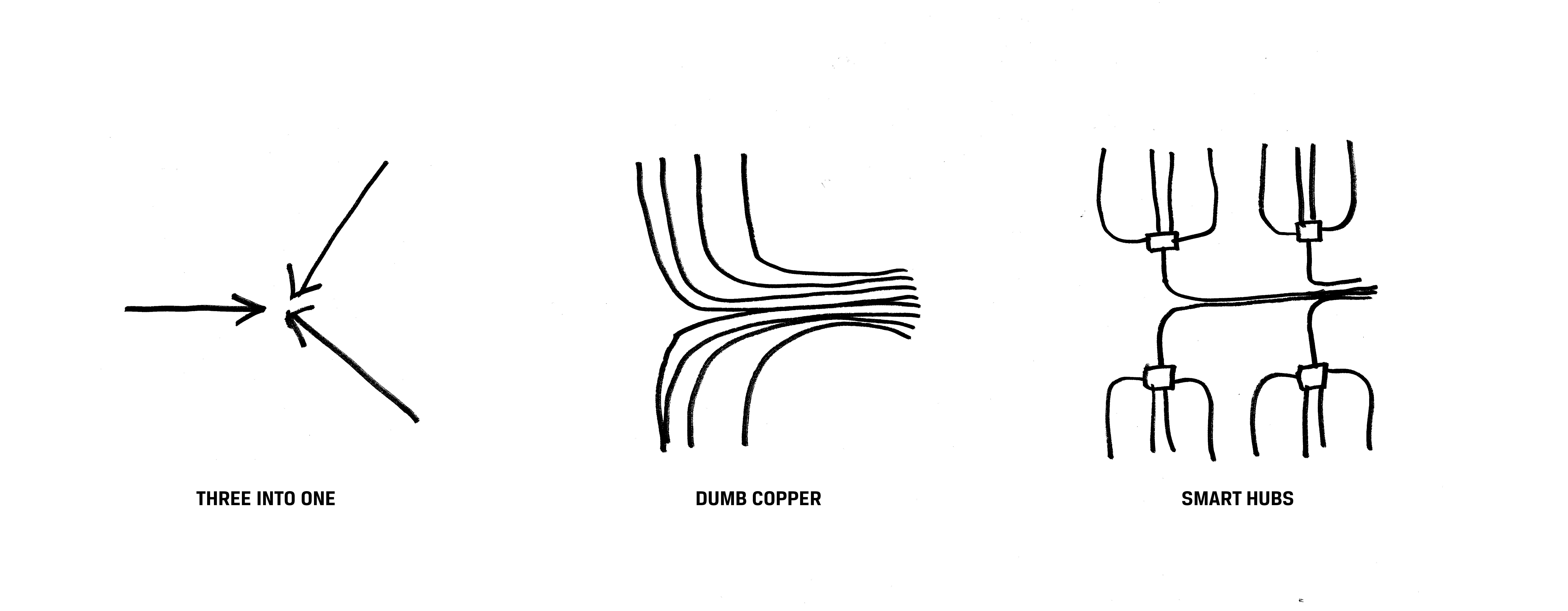
So instead of adjusting the design, we reframed it. We worked both ends at once. At a strategic level, we challenged the underlying system approach—where centralisation made sense, where distribution added value, and where both had been applied without intent. At the same time, we pushed down into the detail, stripping back what each space actually needed and removing the quiet accumulation of “just in case” capacity that builds up in most designs. Thinking big, and thinking small, at the same time.
The Shift
The shift wasn’t about changing equipment. It was about changing logic. We centralised where scale delivered efficiency. We minimised and
distributed only where it genuinely improved performance. In doing that, we removed layers of infrastructure that had been carried forward
simply because that’s how these buildings are usually done. The result was a leaner system—electrically, spatially, and commercially. The
electrical services moved toward a $3 million target, effectively halving the original position.
What about our fee?!
But the impact didn’t stop there. When we saved 50% of the quoted price and sought some reward for this effort, we were advised that there was no money for our fee! We suggested that if we could find more savings could we have half? The answer was off course! And so we began again.
We examined the hydraulic and mechanical solutions with the aim of relocating their multiple risers (which matched the now redundant electrical ones) to enable reduction in corridor size.
Because the services were no longer dictating oversized pathways, the building itself could change. Corridor service zones disappeared, and vertical distribution was simplified. The overall building perimeter was reduced by approximately 800 mm, this applied across six levels and translated into around $400,000 in concrete and steel savings. One line of thinking changed the outcome of the entire project… AND WE GOT PAID!
This was re-valuing engineering. Nothing was stripped out after the fact. No compromises were made to compliance or function: in fact, because of the smart tech used a lot of functionality and smarts was added.
The uncomfortable truth is that most projects don’t fail because of bad engineers. They fail because good engineers are working within unchallenged assumptions. Unrealistic budgets, low fees and short time frames. As a result, they apply known solutions. They follow established patterns. They deliver compliant outcomes. And the project carries the cost. You don’t achieve a 50% saving by refining a design. You achieve it by questioning whether the design should exist in that form at all. That requires a different mindset. One that understands what’s available, what’s possible, and what actually matters to the building.
Compliance would have delivered a $6 million outcome. Engineering thinking delivered a $3 million solution.