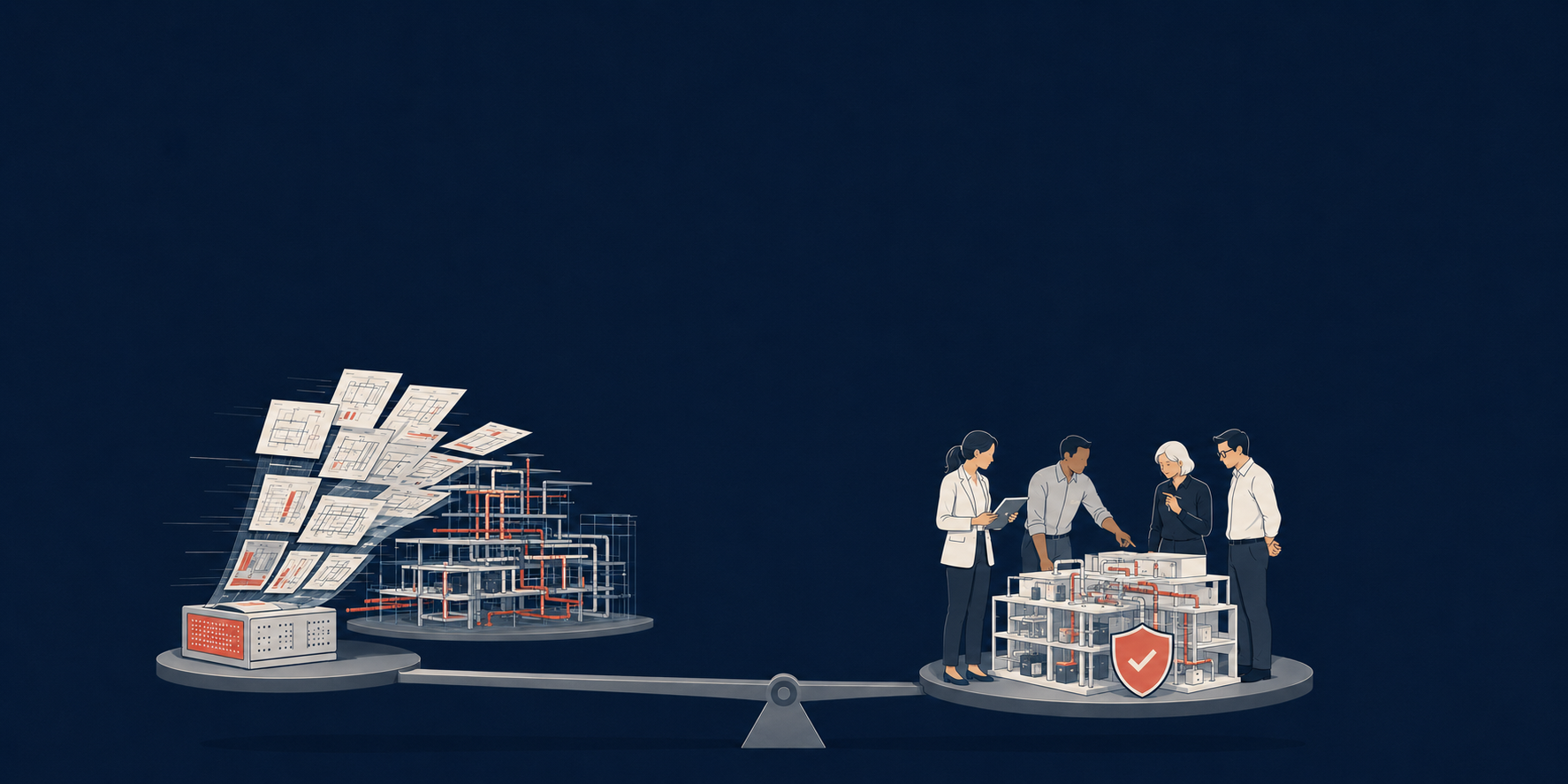
Does AI make engineering cheaper?
AI will make parts of engineering and design faster. Whether that produces lower fees, higher margins or better client outcomes will depend on whether consulting practices understand—and can explain—the value of what they do.
Artificial intelligence is beginning to reduce the time required to research, calculate, draft, document, coordinate and review professional work.
This raises an unavoidable question:
If AI allows engineers and designers to produce work more quickly, should their fees become cheaper?
For some services, the answer will be yes.
Activities based largely on repeatable production will become faster and less expensive. Clients will reasonably expect to receive some of those productivity benefits. Practices that continue to price routine work as though it were undertaken entirely through conventional manual processes will face increasing pressure.
However, engineering and design fees do not pay only for production time. They also pay for investigation, coordination, judgement, risk management, quality assurance and professional responsibility.
The more important question is:
How much of the fee relates to producing documents, and how much relates to developing, verifying and accepting responsibility for the solution?
Many consulting practices cannot currently answer that question.
Not every part of the service will become cheaper
AI can potentially accelerate:
- research and information retrieval;
- preliminary calculations;
- option generation;
- report and specification drafting;
- drawing and model production;
- schedules and equipment selections;
- coordination reviews;
- document checking;
- meeting minutes;
- project administration.
These are substantial opportunities. However, producing information is only one part of a professional consulting service.
The consultant must still:
- define the actual problem;
- confirm that the available information is reliable;
- determine which legislation, codes and standards apply;
- select an appropriate design methodology;
- understand the project and operational context;
- coordinate with clients, architects, contractors and other disciplines;
- identify errors or unsupported assumptions in AI-generated material;
- evaluate safety, compliance, constructability and maintainability;
- review and approve the completed work;
- accept professional responsibility for the outcome.
AI may create almost unlimited production capacity. It does not create unlimited professional judgement, client decision-making capacity or statutory accountability.
These will remain scarce—and valuable—elements of engineering and design services.
The industry has made its value difficult to see
Consultants commonly describe their services through deliverables:
- drawings;
- reports;
- calculations;
- specifications;
- models;
- schedules;
- inspections;
- certificates.
The problem is that deliverables do not reveal the process behind them.
A completed drawing can appear deceptively simple, even though it may represent weeks of investigation, coordination, analysis, option assessment and review. If the client only sees the drawing, it is understandable that faster drawing production would appear to justify a substantially lower fee.
This is partly an industry-created problem.
Fee proposals often explain what will be issued without adequately communicating:
- what must be investigated;
- what information must be obtained;
- which decisions must be made;
- what alternatives will be considered;
- what risks are being managed;
- how coordination will occur;
- what will be tested and checked;
- who will review the work;
- what responsibility the consultant will accept.
If clients do not understand the process, they will struggle to value the solution.
When competing consultants all appear to offer the same drawings and reports, clients are left to compare what is most visible: the programme and fee. AI will intensify this problem by making the visible outputs easier and faster to produce.
The industry cannot expect clients to value differences it has failed to explain.
Cheaper production does not automatically mean cheaper value
Consider a design service that previously required 100 hours. AI might reduce the production component from 60 hours to 20 hours, while investigation, coordination, consultation, checking and approval continue to require 40 hours.
The total effort has reduced from 100 hours to 60 hours. That is a significant productivity improvement, but it does not mean that the complete professional service has become almost free.
Nor does a reduction in hours necessarily reduce the value of the outcome. A compliant, coordinated, efficient and maintainable design may have the same—or greater—value to the client regardless of how quickly the documents were produced.
The commercial question is how the productivity benefit will be shared.
Possible outcomes include:
- lower fees;
- higher consultant margins;
- shorter programmes;
- more comprehensive investigation;
- greater option testing;
- improved coordination;
- additional quality assurance;
- better project outcomes;
- a combination of these benefits.
Consultants should not assume that every efficiency belongs to the practice. Clients will expect a benefit.
Equally, clients should not assume that every hour removed from production should be deducted from the fee. The practice must invest in software, training, data, governance, implementation and professional review to create and manage the improvement.
A sustainable model must create value for both parties.
If clients do not understand the process, they will not value the solution
Making the process visible does not mean overwhelming clients with internal task lists or attempting to justify every hour charged.
Clients generally do not want to purchase activity. They want a successful outcome.
However, they need sufficient visibility to understand:
- what decisions are required;
- what information is necessary;
- what risks are being controlled;
- what expertise is being applied;
- where interdisciplinary coordination is required;
- what review and assurance will be undertaken;
- what professional responsibility is being accepted;
- how the process contributes to a better outcome.
Instead of saying:
We have allowed 80 hours for detailed design.
The stronger explanation is:
We will investigate the available options, coordinate the preferred solution with the architecture and other services, test its performance, confirm compliance, document the agreed solution and undertake an independent technical review before issue.
The hours remain important internally. The client proposition is based on the quality, reliability and risk reduction achieved through the process.
Timesheets still matter—for now
If AI is likely to make time-based fees less relevant, why should consulting practices continue tracking time?
Because without a reliable baseline, a practice cannot determine:
- which activities AI has made faster;
- how much time has actually been saved;
- whether effort has disappeared or moved elsewhere;
- whether review and checking time has increased;
- whether rework has reduced;
- whether quality has improved;
- whether the project programme has shortened;
- whether fees should change;
- whether the practice or client received the productivity benefit.
The strategic question becomes:
If your practice is not currently tracking where time is spent, how work moves and what outcomes it produces, how will you calculate the effect of AI on your services and fees?
Timesheets should therefore be seen less as the permanent basis for valuing professional work and more as part of the evidence required to understand and redesign it.
Time information must also be connected to something meaningful. Recording eight hours against a project provides limited insight. Recording those hours against a stage, discipline and deliverable helps reveal what the service actually costs to produce.
Practice management is the start of the AI process
Practice-management systems connect the information needed to understand how a consulting business operates:
- opportunities and fee proposals;
- agreed scope and exclusions;
- project stages and disciplines;
- deliverables and tasks;
- responsibilities and approvals;
- planned and actual effort;
- remaining effort;
- skills and availability;
- variations and additional services;
- invoices, WIP, costs and margins;
- project outcomes.
This creates a working operational model of the practice.
Without that model, an AI initiative may automate individual tasks while leaving the overall delivery process unchanged. A report may be drafted more quickly, but the practice may not know whether the complete service was delivered more efficiently, more profitably or to a higher standard.
Operational visibility allows the practice to distinguish between:
- repeatable production that can be automated;
- coordination that can be assisted;
- decisions that require experienced judgement;
- reviews that require qualified professionals;
- approvals and certifications that carry legal responsibility.
That is the information needed to redesign the service and explain its future fee.
Practice management is not simply staff surveillance
The objective should not be to record every mouse click, email or minor activity. Excessive tracking creates noise, generates resistance and risks turning practice management into employee surveillance.
The useful baseline should include:
- time by project, stage, discipline and deliverable;
- original, actual and remaining effort;
- deliverable status;
- review and approval requirements;
- rework and repeated revisions;
- delays caused by unavailable information;
- changes to scope;
- variations and additional services;
- staff capabilities and responsibilities;
- fees, costs, invoices and forecast margins.
The information should be collected consistently and with minimal manual effort.
It must also be accessible. A system that stores detailed information but only provides inflexible reports will restrict both management analysis and future AI use. Detailed exports and a documented application programming interface are therefore strategic requirements, not optional technical features.
Engineering fees may divide into two markets
AI is likely to accelerate the separation of consulting services into two broad markets.
Commodity production services
These services will become increasingly standardised, automated and price-competitive. They may include routine documentation, standard schedules, basic calculations and repeatable design packages.
Fees for these services are likely to fall.
Professional judgement and assurance services
These services depend on experience, complex coordination, risk assessment, specialised advice, review, certification and responsibility for outcomes.
Their value may remain stable or increase, particularly where projects are complex or the consequences of failure are significant.
The risk arises when firms describe both forms of service in the same way. If high-value professional judgement is packaged simply as “prepare drawings and specifications”, clients will treat it as production work and expect an AI-driven price reduction.
Fee proposals must change
Future proposals should communicate three connected elements.
1. The outcome
What client objective will be achieved? What problem will be solved or risk reduced?
2. The process
What investigation, analysis, option assessment, coordination, testing, documentation and review are necessary?
3. The responsibility
What expertise, assurance, certification and professional accountability will the consultant provide?
This makes it possible to explain how AI will be used without reducing the service to the number of hours required to produce documents.
A future proposition may be:
We use AI and digital systems to reduce repetitive production, test more options and identify coordination issues earlier. Our fee reflects the complete professional service, including investigation, design judgement, consultation, verification, quality assurance and responsibility for the issued solution.
Will engineering and design fees become cheaper?
Some will.
Routine, repeatable and production-heavy services should become cheaper as AI increases competition and reduces delivery costs.
Complex services involving judgement, coordination, assurance and professional responsibility will not necessarily become cheaper. However, consultants will need to explain and demonstrate why these services remain valuable.
The practices most exposed are those that:
- cannot identify where time is currently spent;
- do not understand the cost of individual deliverables;
- cannot distinguish production from professional judgement;
- rely on document volume to demonstrate value;
- cannot measure the productivity gains created by AI;
- cannot explain their process to clients.
The practices best positioned to benefit will use AI to produce better outcomes, not merely cheaper documents. They will understand their processes, measure improvements and explain clearly what the client is paying for.
The central message is:
AI will make engineering and design production cheaper. Whether it makes the complete professional service cheaper depends on how much value lies in production—and how much lies in judgement, coordination, assurance and responsibility.
Appendix A – Practice-Management and Resource-Planning Systems
The following platforms are examples of systems that may assist consulting practices to establish the operational visibility required to measure and manage AI-driven change.
Their inclusion is not an endorsement. The descriptions are based substantially on information published by the respective vendors. Capabilities, integrations, pricing, security, data access and suitability should be independently confirmed using the practice’s own requirements and project data.

A1. Drum
Website: https://getdrum.com/
Drum is an Australian-built practice-management and professional services automation platform directed towards engineering, architecture and other built-environment firms.
It connects:
- CRM and opportunity pipeline;
- fee proposals;
- projects, stages and tasks;
- project budgets;
- resource planning;
- time and costs;
- work in progress;
- invoicing;
- margins and reporting;
- Xero, MYOB and QuickBooks.
Drum is particularly relevant to Australian practices because it is developed for the local built-environment market and connects project operations with Australian accounting systems.
Its suitability should be tested against requirements for remaining-effort management, skills-based scheduling, programme dependencies,
multidisciplinary and multi-office reporting, document control, API access, Power BI connectivity and AI capability.

A2. Total Synergy Website: https://totalsynergy.com/
Total Synergy is an established practice-management platform developed specifically for architecture and engineering businesses.
Its functions include:
- project accounting;
- projects, stages and tasks;
- timesheets and expenses;
- work in progress;
- invoicing;
- resource planning;
- revenue forecasting;
- reporting;
- document management;
- project portals;
- connections with Xero, MYOB and QuickBooks.
Total Synergy’s Australian origin and A&E-specific structure make it a strong candidate for firms seeking to connect project stages, resources, WIP, invoicing and financial performance.
Practices should confirm which subscription edition includes the required resource-planning, multi-office, reporting and data-access functionality.
3. Fresh Projects
Website: https://www.gofreshprojects.com/
Fresh Projects is practice-management software developed for architects, engineers and other built-environment professionals.
Its functions include:
- fee calculation;
- project and custom stages;
- mixed fee arrangements;
- variations and scope changes;
- timesheets and expenses;
- resource planning;
- profitability reporting;
- invoicing;
- integration with accounting systems, including Xero.
Fresh Projects appears particularly strong in connecting fee development, stages, resources, variations and project profitability.
Practices should confirm the depth of detailed task planning, programme management, document control, workflow automation, data export and
AI capability required for their operation.

A4. Accelo
Website: https://www.accelo.com/
Accelo is a professional services automation platform connecting:
- CRM and client management;
- opportunities and quotations;
- projects and tasks;
- resources and schedules;
- time and expenses;
- retainers;
- billing;
- project and financial performance.
Following its acquisition of Forecast, Accelo is also promoting predictive project forecasting, resource planning, capacity management and AI-assisted operational decision-making.
Practices should test whether its underlying data model, exports and API provide the detailed information required for:
- deliverable-based planning;
- skills and discipline analysis;
- contractual milestone dates;
- remaining-effort forecasting;
- independent resource modelling;
- Power BI or other external reporting.
AI capability will only be valuable if the underlying operational information is complete, correctly structured and accessible.

A5. Scoro
Website: https://www.scoro.com/
Scoro is a broader professional services automation platform supporting consultancies, agencies, information technology businesses and architecture and engineering firms.
Its functions include:
- CRM and pipeline management;
- quoting and budgeting;
- project and task management;
- resource and capacity planning;
- retainers;
- time recording;
- invoicing;
- costs;
- financial reporting;
- multi-office and multi-currency operation.
Scoro offers a broad quote-to-cash operating model. Its suitability for Australian A&E practices should be assessed against requirements
for local accounting integration, project stages, variations, document control, certification responsibilities and discipline-based resource
planning.

A6. Monograph
Website: https://monograph.com/
Monograph is a modern practice-management platform built specifically for architecture and engineering firms.
Its functions include:
- pipeline management;
- proposal preparation;
- opportunity forecasting;
- project and phase budgets;
- staffing;
- time recording;
- project management;
- consultant coordination;
- invoicing and payments;
- project accounting;
- project and firm performance reporting.
Monograph appears particularly suited to smaller and medium-sized A&E firms seeking an accessible system that staff will use consistently.
However, Monograph currently identifies its principal market as US-based architecture and engineering firms of approximately 5–50 people. Its project accounting is closely connected with QuickBooks Online.
Australian practices should confirm Xero availability, Australian GST and invoicing support, local implementation, multi-office capability,
skills-based scheduling, data exports and API coverage.

A7. Runn
Website: https://www.runn.io/
Runn is primarily a resource and capacity-planning platform rather than a complete practice-management or professional services automation system.
Its functions include:
- resource scheduling;
- capacity and demand planning;
- project phases and assignments;
- staff availability;
- utilisation forecasting;
- time recording;
- skills-based allocation;
- workload and financial forecasting;
- scenario planning;
- resource reporting.
Runn’s strength is its ability to provide visibility into future workloads and resource demand. It is intended to help businesses determine:
- whether they have capacity to accept new work;
- where workloads are becoming excessive;
- which skills will be required;
- when recruitment or subcontracting may be necessary;
- how pipeline opportunities could affect future demand.
Runn may be most useful as a specialist planning layer where the principal practice-management system cannot deliver adequate resource and capacity forecasting.
It should not automatically be regarded as a replacement for systems managing CRM, detailed project delivery, WIP, variations, invoicing and project accounting.
A8. Comparative Positioning
| Platform |
Primary position |
Australian A&E relevance |
Principal matter to test |
| Drum |
Integrated Australian built-environment practice management |
Very strong |
Advanced planning, data access and AI maturity |
| Total Synergy |
Established A&E project accounting and practice management |
Very strong |
Subscription levels, flexibility and reporting |
| Fresh Projects |
A&E fee, stage and profitability management |
Strong |
Workflow depth, document control and automation |
| Accelo |
Professional services workflow automation and predictive planning |
Moderate–strong |
Data model, exports and skills-based resourcing |
| Scoro |
Broad professional services automation |
Moderate |
Australian A&E workflow and accounting fit |
| Monograph |
Modern A&E firm management |
Limited–moderate |
US focus and QuickBooks orientation |
| Runn |
Specialist resource and capacity planning |
Complementary |
Not a complete practice-management platform |
A9. The Essential Test
The most important assessment question is not whether a system advertises AI.
A consulting practice should determine whether the platform can provide the structured, reliable and accessible information needed to answer:
- What does each service currently cost to deliver?
- Which activities are production, coordination, judgement and assurance?
- What was originally planned?
- What effort has been consumed?
- What remains to be completed?
- Where has AI reduced effort?
- Has effort been eliminated or moved into checking and review?
- Has rework reduced?
- Has quality improved?
- What productivity benefit should be passed to the client?
- What fee will sustainably support the remaining professional responsibility?
A software demonstration should use the practice’s own project structure, fee stages, disciplines, deliverables and resource data.
If a platform cannot provide this evidence, it may improve administration, but it will not provide a reliable foundation for redesigning professional services or engineering and design fees around AI.