Vivid Memories
Haron Robson and Sydney’s Festival of Light
Vivid Sydney 2026 endedone week ago, and for Haron Robson it brings back more than festival memories.
Our connection with Vivid goes back to its early years, before it became the major public spectacle it is today. At that time, Vivid was still emerging as a new way of thinking about Sydney at night — more experimental, more intimate, and more focused on what light could do in public space.
Haron Robson supported members of our lighting team to participate in those early projects, with our electrical team helping make the ideas possible. Projects such as LightWaveAction and Infinity Squared were not conventional building projects. They were temporary installations, open to everyone, and judged immediately by the public as people walked through the city at night.
That is what made those early Vivid projects important. They showed that lighting is not just technical. It is creative, emotional, civic and memorable.
People may not talk about colour temperature, controls, optics, glare or power distribution, but they immediately understand when a place feels alive. They notice when a street draws them in. They remember when a building, pathway or public space becomes part of the city’s night-time identity.
For us, the lesson was simple and lasting: light can change how people see, use and remember a place.
That thinking still shapes our work today. Whether we are designing for buildings, public spaces, hospitality venues, landscapes or temporary events, we see lighting as more than illumination. It is one of the tools that helps create experience, identity and connection.
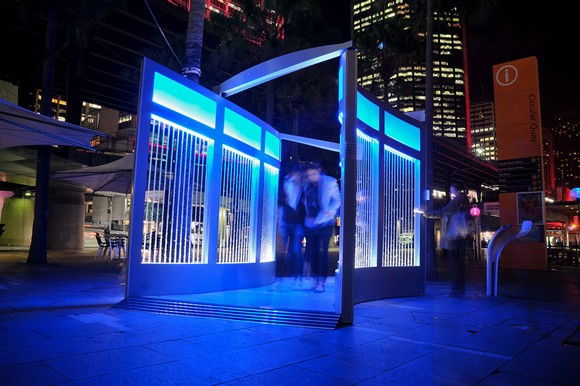
Light Wave Action - 2011
Artist:
Bow Jaruwangsati, Christa van Zoeren & Kristy Phillip
Collaborators:
3S Lighting / Osram / Symonite
Light Wave Action was created for Vivid Sydney, celebrating Sydney’s harbour setting through light, form and movement. The installation was designed as a walk-through sculptural experience, inviting visitors to move within the artwork rather than simply view it from a distance.
The sculpture featured multiple wave-like forms, representing wavelengths and the movement of waves. Vertical white ropes gave the structure a semi-translucent appearance during the day, while at night the installation transformed into a vivid blue illuminated form through low-energy LED lighting.
Inspired by nature and the harbour surrounds, Light Wave Action reflected the subtle colours of twilight skies and paid homage to the sea, particularly the power, rhythm and formation of waves. Its immersive form created a multi-sensory experience for visitors, combining light, structure and audio to heighten the atmosphere of the work.
The project demonstrated Haron Robson’s ability to combine creative lighting design with technical collaboration, working with manufacturers and lighting suppliers to deliver a public artwork that was both visually striking and energy efficient.
Country represented by installation: Australia
T-Square and a dress - 2017
Artist:
Haron Robson & IA Design: Jenny Oxley (Australia) / Josh
Webb (Australia) / Raquel Chiusoli (Australia) / Greg Reardon (Australia)
Collaborators:
Automated Controls (Australia) / Epson (Australia) / Australian Scaffolding (Australia) / BE Productions (Australia) / BG&E Engineers (Australia)
T-Square and a dress is intended to create familiarity and awareness of the female influence on our built environment. The installation covers a little history in an ingenious and playful way; first drawing on various architectural structures dating from the nineteenth century when Australian women’s contributions to architecture was mostly through background influence or by commissioning buildings.
It then introduces us to some of Australia’s first qualified female architects: Florence Taylor (1879–1969), Ruth Alsop (1879–1976) and the astounding Marion Mahony Griffin (1871–1961) who, with her husband Walter Burley Griffin, created the vision for Australia’s new capital, Canberra.
From there the display moves through to the mid-twentieth century, when there were many females in practice, often as part of husband-and-wife teams. It concludes with examples of Australian women architects who currently excel in the field.
The fascinating narrative of this work also highlights the continuing struggle experienced by women in the field and the need to tackle long-ingrained attitudes and stigmas associated with women in construction industries.
Country represented by installation: Australia
.jpg)
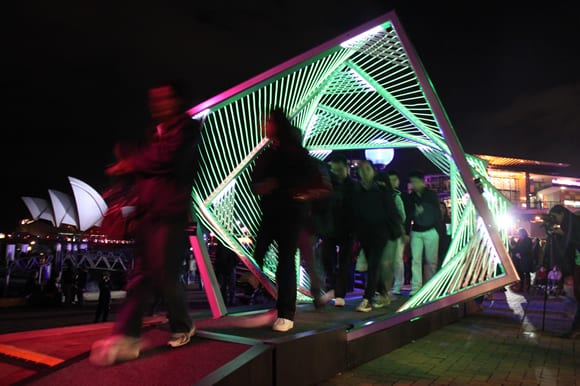
Infinity Squared - 2012
Artist:
Haron Robson: Bow Jaruwangsanti, Christa van Zoeren, Kristy Phillip & Catalina Chica
Collaborators:
3S Lighting / Superlight / Vivid Sydney
Infinity Squared was created for Vivid Sydney 2012. Designed as an interactive, walk-through light sculpture, the installation invited visitors to physically enter and experience a glowing geometric structure from within.
The sculpture used illuminated glow wires fixed to a steel fabricated frame, creating a layered visual effect that shifted as people moved through and around the work. The structure’s repeated square forms and bright blue lighting created a sense of depth, reflection and movement, turning a simple architectural form into an immersive public artwork.
As part of the Vivid Light Walk, Infinity Squared encouraged public interaction and engagement, becoming a destination within the festival rather than only a sculpture to be viewed from a distance. The project also demonstrated Haron Robson’s ability to combine lighting design, fabrication coordination and public art in a highly visible urban setting.
The installation was recognised with the IES New South Wales Luminaire Design Award of Excellence in 2012, highlighting its success as both a creative light sculpture and a technically resolved lighting installation.
And more shaping Sydney After Dark.. permanently Vivid
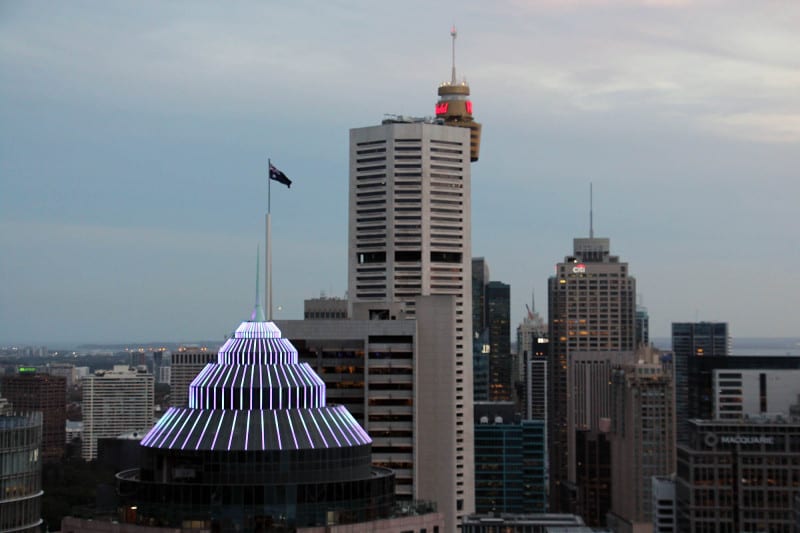
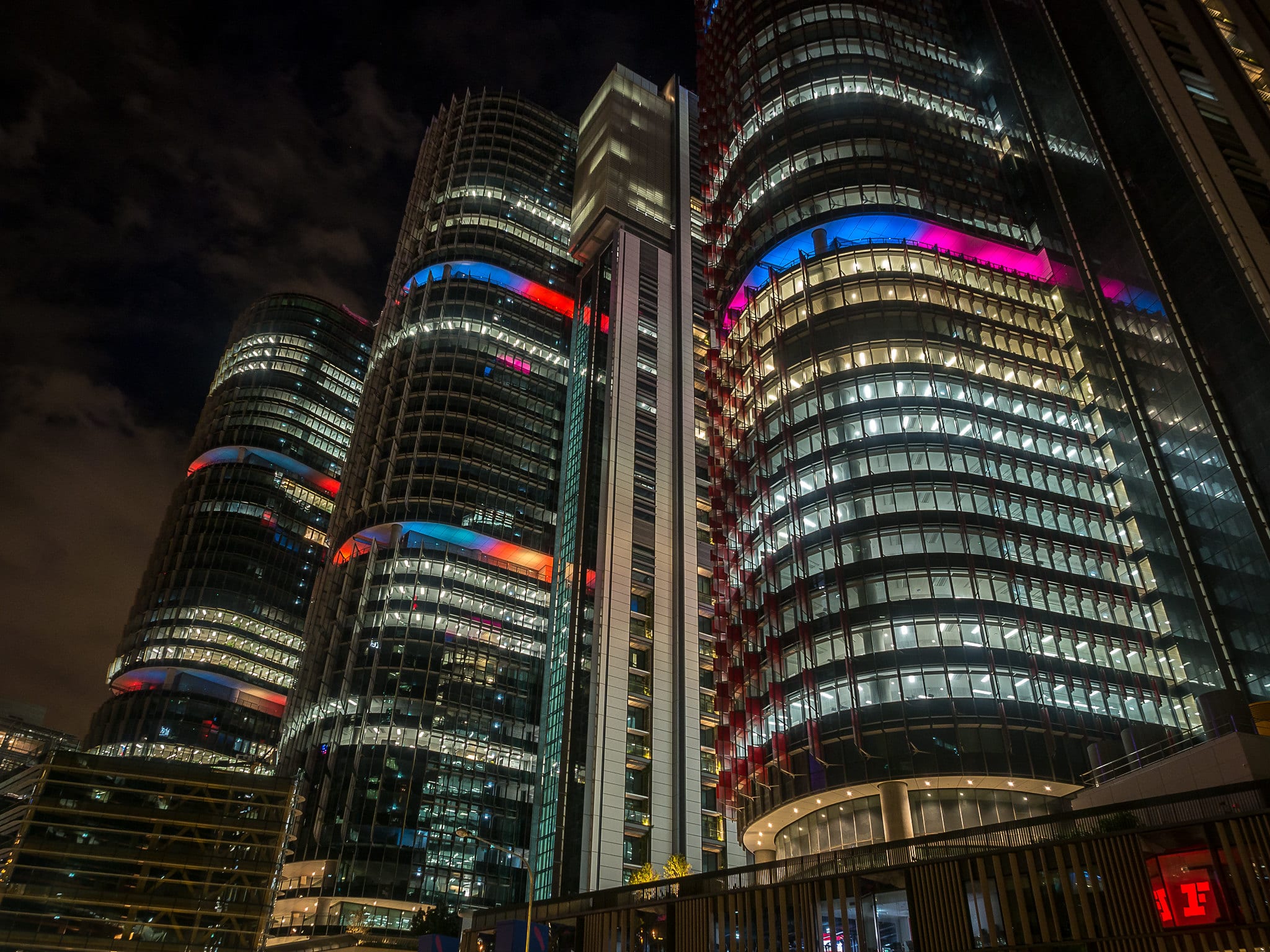
Haron Robson’s work has also contributed to more permanent night-time places in Sydney, including lighting installations at Pitt Street Mall, International Towers Barangaroo and 1 O’Connell Street. Unlike festival works, these projects do not disappear after a few weeks. They continue to shape how people see, use and remember the city after dark.
The useful lesson from Vivid is not that every project should be theatrical. It is that light has public value. It can change perception, encourage movement, create identity and make places more memorable. That has been part of Haron Robson’s work for decades: using light carefully, technically and creatively to make places better.